Power Interest Grid: A Worked Example for Software
· 7 min read
A power interest grid sorts stakeholders by two questions: how much can this person affect the project, and how much do they care about it? The answers put each person in one of four quadrants, and each quadrant suggests how much effort to spend on them. Below is the grid, a way to place people on it, and a worked example with eight invented stakeholders from a software project.
The four quadrants
The grid is often called Mendelow's matrix, after Aubrey Mendelow, who is cited for it in 1991. A course from the Open University describes it as a power and interest grid with four quadrants (Open University, Successful IT systems). The usual labels are these:
| Low interest | High interest | |
|---|---|---|
| High power | Keep satisfied | Manage closely |
| Low power | Monitor | Keep informed |
What each label means in a software project:
- Manage closely (high power, high interest): they decide and they care. Involve them in decisions and sign-off.
- Keep satisfied (high power, low interest): they can stop the project but do not follow it daily. Do not overload them, and make sure their concerns are met before they become vetoes.
- Keep informed (low power, high interest): they will use or live with the result. Their input improves the product, and their support helps adoption.
- Monitor (low power, low interest): light attention only. Check from time to time that their position has not changed.
Placing people on the grid
You do not need a precise method. A simple approach works:
- List the people first, using a stakeholder analysis. Names, not teams.
- Rate power from 1 to 5. Ask: can this person approve, block, fund or change the scope? A budget holder or the owner of a system you depend on rates high. Someone who only gives opinions rates low.
- Rate interest from 1 to 5. Ask: how much does the outcome change this person's daily work or goals? A daily user rates high. A legal contact who sees the project twice a year rates low.
- Place anyone at 4 or above on both as "manage closely", and split the others by whether power or interest is the high one. The line at 3 or 4 is a judgement call; decide it once and use it for everyone.
- Ask two other people to check the placements. One person's guess is often wrong about someone else's influence.
Two cautions. Power is not the same as job title: a system owner with no budget can still block you by controlling a release date. And interest is not fixed. A data protection officer may be uninterested until personal data comes up, and then becomes the person who decides.
A worked example
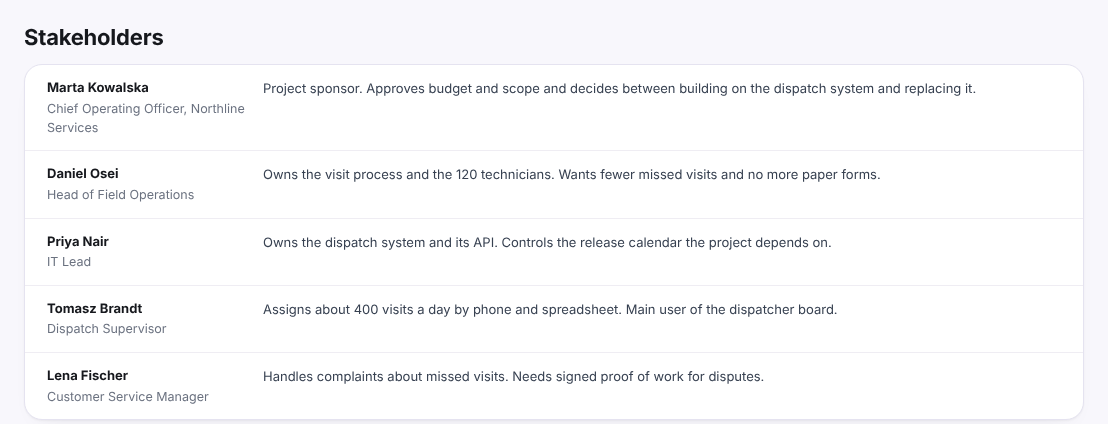
The project is Fieldwise, an invented app for field technicians of an invented company, Northline Services. Five of the stakeholders below also appear in the public example report, and three are added here. Every name and detail is made up.
| Stakeholder | What they own or need | Power | Interest | Quadrant |
|---|---|---|---|---|
| Marta Kowalska, Chief Operating Officer | Sponsor; approves budget and scope | 5 | 4 | Manage closely |
| Daniel Osei, Head of Field Operations | Owns the visit process and the technicians | 4 | 5 | Manage closely |
| Priya Nair, IT Lead | Owns the dispatch system and its release calendar | 4 | 3 | Keep satisfied (watch closely) |
| Finance controller | Controls the budget release | 4 | 2 | Keep satisfied |
| Data protection officer | Must approve how personal data is handled | 4 | 2 | Keep satisfied |
| Tomasz Brandt, Dispatch Supervisor | Main user of the dispatcher board | 2 | 5 | Keep informed |
| Technician representative | Speaks for the people who use the app daily | 2 | 5 | Keep informed |
| Lena Fischer, Customer Service Manager | Needs signed proof of work for disputes | 2 | 3 | Monitor (move up if disputes grow) |
The ratings are an opinion, not a measurement. Two points show why they need a second look:
- Priya Nair scores only 3 for interest, but she controls the release calendar the project depends on. A person who can delay a milestone deserves more attention than the grid alone suggests, so place her at the edge of the "manage closely" quadrant and give her a regular slot.
- Lena Fischer sits in "monitor", but her need, signed proof of work, becomes a requirement. If the volume of disputes rises, her interest moves up.
What to do for each quadrant
Turn the placement into actions with a name and a rhythm:
| Quadrant | Action | Rhythm |
|---|---|---|
| Manage closely | Involve in decisions; give a short written summary before each review; get sign-off from them | Weekly |
| Keep satisfied | Meet early to ask for their conditions; confirm before decisions that touch their area | At key points |
| Keep informed | Interview for needs; show screens and flows; collect their reaction | Every two weeks |
| Monitor | Send the project summary; check that their position has not changed | Monthly |
For the example project: Priya gets a short call each week about the two new API endpoints the project needs. The data protection officer sees the data-handling requirement before it is final. The technician representative sees each screen. Lena receives the summary and is asked only if the proof-of-work requirement changes.
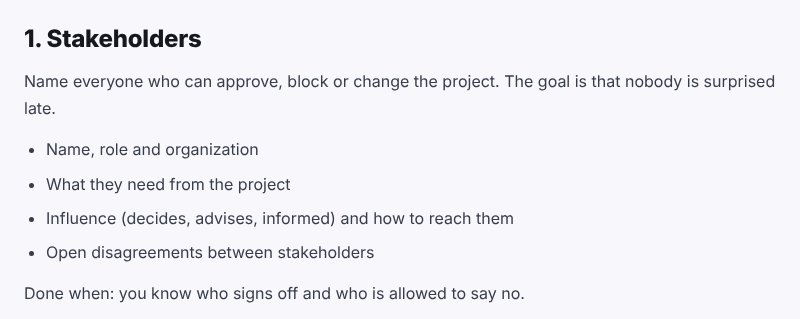
The grid is also a sign-off map. The people in "manage closely" and "keep satisfied" are the ones whose agreement you must have in writing before building starts. The discovery phase template puts stakeholders first for that reason, with who signs off and who may say no:
Mistakes to avoid
- Sharing the grid. It contains your opinion about people's influence. Keep it as an internal working document.
- Making it once. Placements change when the scope, the budget or the people change. Review it at each milestone.
- Treating "monitor" as "ignore". Low power and low interest today can turn into a surprise if their area is touched later.
- Using it as a substitute for talking to people. The grid says whom to talk to and how often. It does not tell you what they want.
- Putting everyone in "manage closely". If a quadrant has no one in it, check whether you are skipping the people who say no late, such as security, legal and procurement.
- Skipping the disagreements. When two people in "manage closely" want different things, that is a finding for the sponsor, not a scheduling problem. Record it in the open questions and assumptions log.
The grid works best next to the rest of the discovery: it picks the interviews, the interviews fill the requirements, and the sign-off list comes from the top two quadrants. For the wider picture of what the phase includes, see what a discovery phase is in software development.