PRD vs BRD vs SRS: Which Requirements Document Do You Need?
· 7 min read
A BRD (business requirements document) explains why a project exists and what the business needs from it. A PRD (product requirements document) describes what the product does for its users. An SRS (software requirements specification) states, precisely enough to build and test against, how the system must behave. Most small projects need the content of all three but not three separate files.
The three documents in one table
The names are used loosely, and two companies can mean slightly different things by "PRD". The table shows the most common reading of each.
| BRD | PRD | SRS | |
|---|---|---|---|
| Question it answers | Why are we doing this, and what must the business get? | What will the product do, for whom? | Exactly how must the system behave? |
| Main readers | Sponsor, budget holder, steering group | Product, design, engineering leads | Developers, testers, integrators, sometimes auditors |
| Usually written by | Business analyst or sponsor | Product manager | Business or systems analyst, tech lead |
| Typical content | Problem, goals, success metrics, scope, constraints, stakeholders | Users, journeys, features, priorities, release scope | Functional and non-functional requirements, interfaces, data, acceptance criteria |
| Typical length (rule of thumb) | 3-10 pages | 5-20 pages | 15-60+ pages |
| Changes how often | Rarely, once approved | Every release or so | With every change request |
| When a small team can skip it | When the sponsor and the product owner are the same person | When the SRS is short and user-centred | When the PRD already has testable requirements |
The lengths are a rule of thumb from typical projects, not a standard. A regulated system can need a far longer SRS; a two-month internal tool might fit all three into twelve pages.
Of the three, only the SRS has a formal standard behind it. ISO/IEC/IEEE 29148 (current edition 2018, which replaced IEEE 830) describes the content of a software requirements specification, and also of a business requirements specification (BRS) and a stakeholder requirements specification. The PRD comes from product-management practice and has no single agreed format.
BRD: why the project exists
The BRD is the document a budget holder reads before saying yes. It should be readable by someone who will never open the code, and it should hold up if the project is challenged six months later.
What goes in it:
- The problem, in business terms: who is affected, what goes wrong, what it costs.
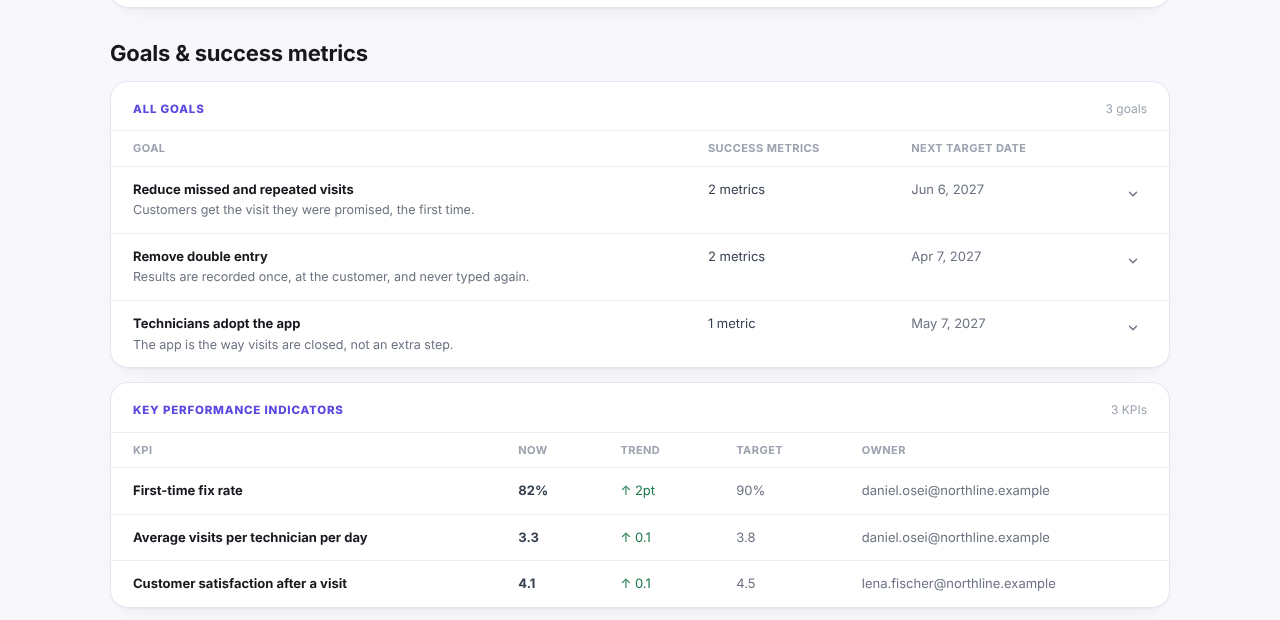
- Goals with numbers: a metric, today's value, a target and a date. "Cut manual order entry from 6 hours to 1 hour a day by Q3" works; "improve efficiency" does not.
- Scope: what is in, and just as important, what is out.
- Stakeholders: who approves, who is consulted, who can block.
- Constraints: budget, deadline, regulation, systems that must stay.
What stays out: screens, feature lists and technology choices. If the BRD names a database, it has drifted into the SRS.
Here is what the goals part can look like in practice, taken from the example report for Fieldwise, an invented field-service project: each goal has its success metrics and a target date, and the KPIs show today's value, the trend and the target.
PRD: what the product does
The PRD turns the business case into a product. Its reader is the team that will design and plan the build, so it is organised around users rather than around the business.
A useful PRD covers:
- The users and actors, with what each is trying to achieve.
- The journeys they take and where they get stuck today.
- The features or user stories, each with a priority (MoSCoW is common: Must, Should, Could, Won't).
- The release scope: what ships first and what waits.
- Open questions and the person who answers each.
A PRD is a living document. It is fine for it to change between releases, as long as the change is visible and the BRD's goals still hold.
SRS: how the system must behave
The SRS is the contract between "what we want" and "what we test". Each line in it should be something a tester can pass or fail. The 29148 standard lists quality criteria for a requirement such as being necessary, unambiguous, feasible and verifiable.
A typical SRS holds:
- Functional requirements: what the system does in response to input ("When an order total is over the customer's credit limit, the system blocks submission and shows the limit").
- Non-functional requirements: performance, security, availability, accessibility, data retention, each with a number.
- Constraints: limits the team cannot change, such as a mandated platform, a regulation or a hosting region.
- Interfaces and data: integrations, formats, who owns which data.
- Acceptance criteria for each requirement.
The SRS gets long because precision is wordy. That is acceptable; vagueness is not.
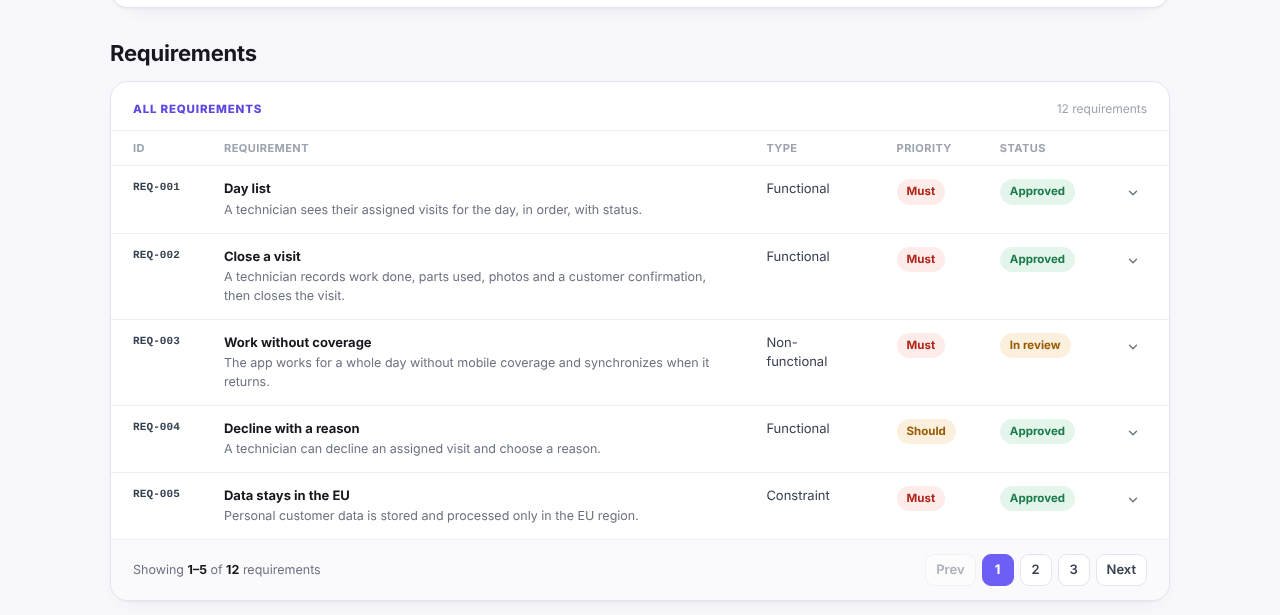
In the same Fieldwise example, the requirements list keeps the three types side by side, each with an ID, a priority and a review status (the acceptance criteria open under each row):
Which one to write first
Write them in the order the decisions are made: business case, then product, then system.
- BRD first. Without agreed goals and scope, every later argument about a feature has no referee.
- PRD second. Once the goals are fixed, decide who the product serves and what it must let them do.
- SRS last, and often in slices: detail the requirements for the first release, and leave later ones at PRD level until they are next.
In practice the three overlap. Interviews for the BRD surface features; writing acceptance criteria reveals a missing goal. Expect to go back and edit, but keep the direction: an SRS line that serves no goal in the BRD is either missing a goal or should not be there.
In a client project, all three usually come out of the discovery phase, the paid stretch before the build where the team settles what to build and what it will take.
What a small team can merge
For a team of two to ten people, three separate documents with three owners is usually overhead. A single requirements document with clearly marked parts carries the same information:
- Part 1, business (the BRD content): problem, goals with metrics, scope in and out, stakeholders, constraints. Two or three pages.
- Part 2, users and scope (the PRD content): users, journeys, prioritised features, first release.
- Part 3, requirements (the SRS content): numbered requirements, each with a type (functional, non-functional, constraint), a priority, acceptance criteria and the goal it serves.
The discovery phase template follows roughly this shape, from stakeholders and problem statement through requirements and roadmap. Discovery Phase AI keeps the same structure as separate project stages: each requirement carries a type, a MoSCoW priority, acceptance criteria and an optional link to a goal, and the whole set exports as one report (you can see one for an invented project on the example report).
What you should not merge away:
- The "why" section. Teams that skip the BRD content end up debating features with nothing to judge them against.
- Acceptance criteria. Without them the requirements part is a wish list, and the estimate built on it is a guess.
- The out-of-scope list. It costs a paragraph and prevents weeks of argument later.
Keep separate documents when the audiences really are separate: an outside sponsor who must approve the business case, a regulator who will audit the SRS, or a vendor contract that refers to a specification by name. Otherwise, one well-structured document read by everyone beats three documents that half the team never opens.